There are no guaranteed secrets or universally proven shortcuts to apply for the scholarship and fellowship opportunities. However, several evidence-based strategies can provide applicants the best possible approach. Applicants often spend several months or even years building their strongest scholarship application before applying it. Here, I would not like to mention the ordinary tips about the general application process: prepare a good CV, write a strong SOP or motivation letter, check deadlines, get good recommendation letters, and apply early. I would like to mainly focus on several evidence-based strategic tips for applying for a scholarship, which can give applicants a more targeted approach. Getting a scholarship and fellowship is not simply about meeting requirements and submitting an application. It is about identifying the right opportunity, understanding what the funding body values, positioning your strengths strategically, building the right academic connections, and presenting a realistic path to meaningful contribution.
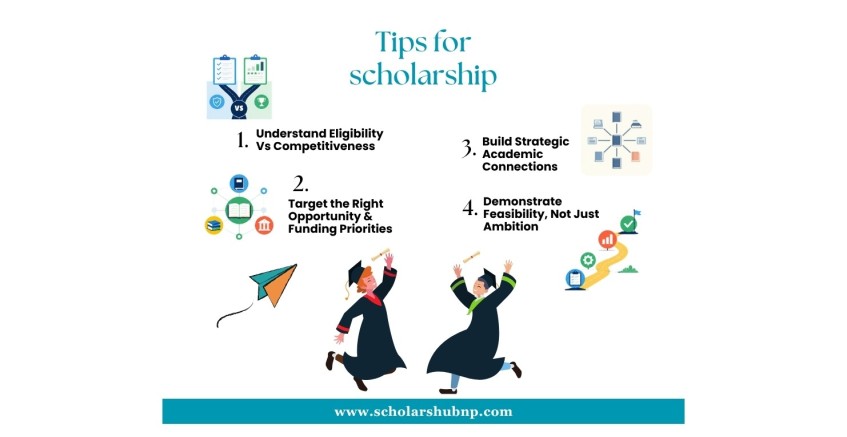
Here are four strategic tips for the scholarship and fellowship application, mainly for Master’s and PhD aspirants.
01. Understand Eligibility Vs Competitiveness
Don't just ask, “Am I eligible?” Ask, “What makes me competitive for this scholarship opportunity?”
Understanding the difference between eligibility and competitiveness can be one of the core strategies you should know while applying for every type of competitive scholarship. If you meet the minimum eligibility requirements, it does not always mean you are a strong candidate; you need to identify what makes your application competitive over other eligible candidates.
For example, a CGPA of 3.0 is a minimum requirement for the scholarship application. An applicant with 3.0 or higher may be eligible to apply for this scholarship; however, that does not tell us how competitive they are against the applicant with stronger academic records, research publications, relevant work experience, other skills, and achievements.
Thus, you need to look beyond eligibility requirements. You need to understand your actual strengths, weaknesses, achievements, and qualifications and identify what makes your profile stand out.
- Identify what the selection committee values: You need to find out which qualities are important for the specific scholarship, such as research potential, academic excellence, leadership, professional experience, innovation, community impact, etc.
- Assess your academic record and experience: You need to evaluate your overall profile, such as your grades, research work, publications, professional experience, skills, and achievements, and see how well it meets the selection criteria of the scholarship.
- Identify your strengths and gaps: You need to recognize where your profile stands and what are the areas you may need to improve further.
02. Target the Right Opportunities & Funding Priorities
You should target the right scholarship opportunity that matches your background and goals, and align with the types of research and activities the university or institution is actively funding. Identifying where you should compete is strategically important while applying for the scholarship. You may have a great profile, but if your proposed goal does not target the right scholarship and does not align with the funding priorities of the institution, then your applicant may be completely on the off track.
Here comes a question: are you putting your effort into the opportunities where your profile has a meaningful alignment? Here are three key alignments you need to consider.
- Scholarship Alignment: Does your profile meet what the scholarship is looking for?
- Institutional Alignment: Does your academic or research direction fit the university or institution
- Funding Priority Alignment: Does your proposed field of study align with the specific priorities of the funding body?
You need to research what exactly the funding body is actively funding and looking to support, such as its priority fields, research direction, development objectives, initiatives, and funding focus. Then, you need to figure out where your academic background, research interests, and proposed contribution genuinely align with those priorities of funding institutions.
The strongest applications do not simply explain why you want the scholarship —they demonstrate why your goals and potential contribution fit what the funder is looking to support.
03. Build Strategic Academic Connections
Building academic connections might not be mandatory in every scholarship, nor it is a formal application process, nor does it guarantee selection; however, developing a genuine academic relationship can be a vital part of the scholarship application that helps applicants to identify suitable academic environments and research alignment, find a potential supervisor, and get valuable guidance and meaningful recommendation, mainly for the research-based Master’s programs, PhD programs, research fellowships, and research grants. Some of the important tips on developing academic connections are as follows:
- Find Potential Supervisors & Research Alignment: Identify potential professors whose research interests, expertise and ongoing research projects align with your academic goals and proposed research. Learn about ongoing research projects, funded positions, assistantships, fellowships and potential collaborations.
- Identify the Right Institution and Research Environment: Explore universities, departments, laboratories and research centers that offer relevant expertise, resources and an academic environment that suits your research interests and future goals.
- Seek Academic Mentorship and Recommendation: Build genuine relationships with professors and mentors who can guide you academically, help you make better-informed decisions, and provide valuable recommendations when needed.
- Understand the Selection Process: Find out whether the chosen program, scholarship, fellowship, or research opportunity requires supervisor approval, departmental nomination, or institutional endorsement, and prepare your application accordingly.
04. Demonstrate Feasibility, Not Just Ambition
A great research idea is not enough. You need to show that you have the necessary skills, previous experience, research preparedness, critical thinking and methodology to achieve your research objectives, as well as you need to demonstrate that your proposed research is practical, potentially valuable and achievable within the available time, resources and academic environment.
For example, instead of simply saying:
“I want to conduct groundbreaking research on climate change.”
A more feasible approach explains – what specific problem you will investigate, what methods you will use, what skills or preparation you have, what resources you need, why the institution is suitable, and how the work is practically achievable within the proposed timeframe.
